
Place value is the most basic and important skill, without which building operations on top of it becomes meaningless. It tells us about the value of each digit in the numbers than seeing it as a separate number. Building number sense becomes easy when one understands the real meaning of the digits in the numbers using place value. This serves as the foundation for reasoning about various mathematical operations.
How to introduce place value concepts?
Well, I would always look in for a puzzle or story book or a game paired with a hands-on activity to introduce a concept. Here is an activity paired with a story book which helps exploring place value contextually.
Using Manipulative to Understand Place Value
Place value can be better understood by visualising the values of numbers using different manipulatives. For example, money provides a real-life context for grasping the concept of place value. Ten 1-rupee coins combine to make one 10-rupee note, and ten 10-rupee notes/coins together form a 100-rupee note.
Visualising the Transition from Ones to Tens
Initially, using money as a manipulative may not clearly demonstrate why ten one rupees are replaced by a single ten-rupee note. The limitation arises because it is not possible to physically split a ten-rupee note into ten one-rupee coins in a way that makes the grouping visually apparent. Therefore, to help one truly understand this transition, it is important to illustrate how a single group of ten represents ten individual ones. By focusing on the idea that “one ten” contains “ten ones”, learners gain a concrete sense of the grouping process that underpins the concept of place value.
Activity
This activity offers learners a tangible way to understand the concept of place value by physically grouping and regrouping items. The process of bundling and unbundling the sticks vividly demonstrates how ten single units are grouped together to form one ten, and conversely, how a ten can be separated back into ten individual ones. This visual and tactile method helps learners internalise the structure of our number system, making abstract concepts more accessible and meaningful.
Materials required:
- Place value chart (available for download at the end)
- Popsicle sticks/straws/match sticks/tooth pick
- Paper/pencil for recording
- Rubber bands
How to get started:
This place value chart helps visualise numbers up to the hundreds place value. It is designed in such a way that it helps one to see how tens of each smaller place value makes the next higher one. This visual structure reinforces the concept of bundling ten items from one column to create a single item in the adjacent column, making the process of grouping and regrouping tangible and easier to understand for learners.
You can print the chart and laminate for more durability.
Let us start this activity with a single digit number say, 8. ‘8 things’ can be shown using 8 popsicle sticks which represents “8 ones”.

Now, let us say we add 2 more popsicle sticks. So, how many do we have now?
We have “10 ones”
“10 Ones” is grouped as “1 Ten” which leads to the following understanding below:

Note: When the number 10 is said, it is important to be seen as “10 Ones” as well as “1 Ten”. Visual models help picture this.
Let us continue to add some more sticks to the number 10. Say, we add 6 more items, which is “6 ones”
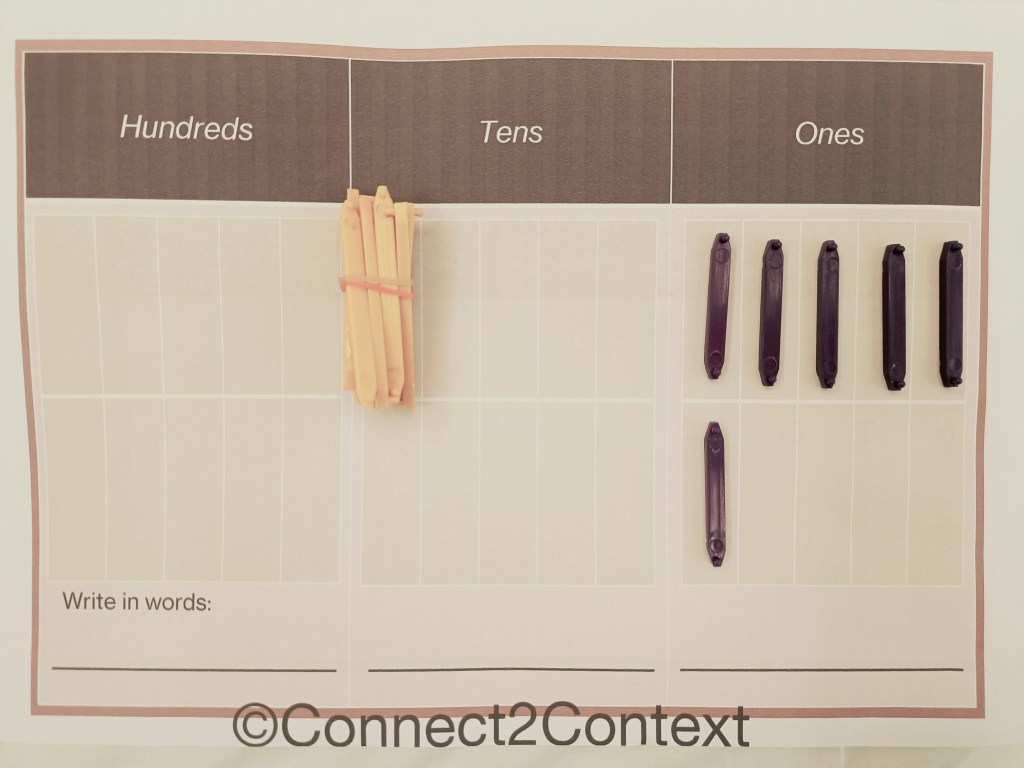
Now, how many do we have? We have 1 ten and 6 ones (or) 16 ones (as 1 ten is equal to 10 ones)

Now, how about we add 4 more sticks to 16. Where will the 4 sticks go?
Let us visualise the model by adding 4 sticks. Adding 4 sticks to the ones place makes it “10 ones”.
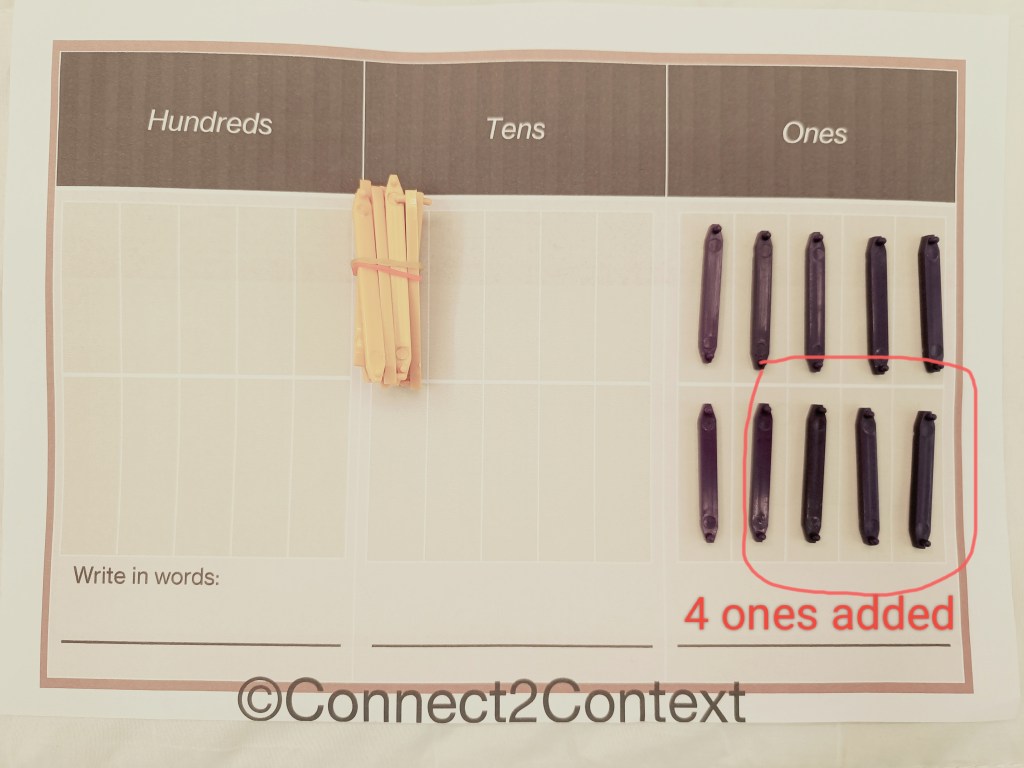
We know that 10 ones can be grouped into “One Ten”.

Now, how many do we have? We have 2 tens (or) 20 ones (as 1 ten is equal to 10 ones)
It is important to say the number in both the ways which helps to see that they are one and the same.
This exercise can be repeated with various numbers up to 100, helping to develop solid reasoning of the place value concept.
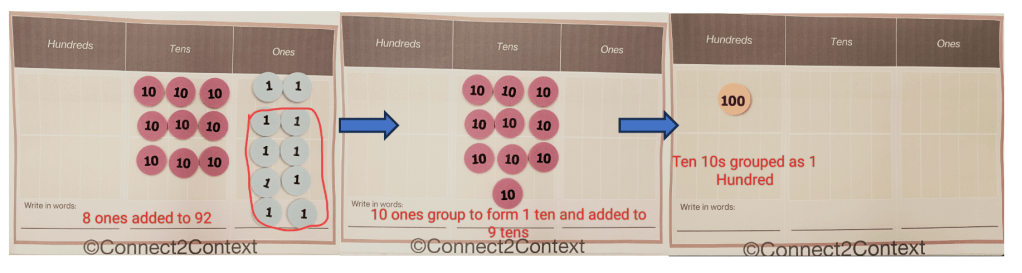
For example: 92 can be formed using 9 groups of ten sticks and 2 sticks.
Once a solid understanding is built, we could extend the same concept to hundreds and furthermore.
Let’s say we add 8 more sticks to 92, we will have 9 tens and 10 ones.
As we know, 10 ones can be grouped into “One Ten”, which will lead to
9 tens + 1 ten = 10 tens.
Now, these “10 Tens” group to form “One Hundred”

Asking questions like “How do you represent the number?”, “Where would you add?” “How many do we have?” will help make thinking visible.
Once the solid understanding of place value is built with the materials that can be regrouped, it can slowly be transitioned to money/play counters/place value disks and other digital manipulatives for more practice.
Example:
How about a story to go along?
Story books incorporating math concepts are available for different reading levels. Some books intend to introduce a math concept with necessary vocabulary, while few others have a story line and help make connections to the topic in hand.
Here’s a story “Earth day – Hooray!” by Stuart J.Murphy which pairs well with the activity above.
You can purchase the book or use this read aloud link, to do this activity
In this story, Maples street school is cleaning a park as part of the year’s Earth day celebration. Ryan and Carly come up with a plan to raise money for planting trees in the park by recycling the waste being collected. The story continues to explore counting using place value by grouping the waste collected into groups of ones, tens, hundreds and thousands.
While reading the story, we can visualise the number using the place value mat and cards (from the printable “Placevalue Chart_Earth day” attached at the end) along with Ryan and Carly.
For example:
When they say, “They ended with three big bags of 100, 5 small bags of 10, and nine single cans”, it could be shown like the one below:

Note: You may print multiple copies of cards to use it for larger numbers.
Asking questions such as , “What do you notice and what do you wonder?”
“How many more are needed to get to the nearest ten?”
“How many more are needed to get to the nearest hundred?” helps make reasoning visible.
The story continues with Ryan and Carly collecting more trash to raise money for planting, which gives more place value examples for us to explore.
Pairing with a story helps understand the place value in real life context and in a more interesting way.
Need more stories?
Here are few more stories which might be helpful to explore concepts in relation to place value.
- Place value by David A.Adler
- Sir Circumference and All the King’s Tens
- Warlords beads by Virginia Walton Pilegard
- More Penguin place value by Kathleen L.Stone
- How much is a million by David M.Schwartz
- This is how you count eggs (Pratham Story)
https://storyweaver.org.in/en/stories/58665-this-is-how-you-count-eggs?mode=read
Hope you had fun exploring place values.
Need more resources? Feel free to email to makelearningcontextual@gmail.com
Want to explore more?
Head over to read on to how understanding place value helps make sense of algorithms
 Connect 2 Context
One response to “How to model place values and their relationship”
[…] (https://connect2context.com/2025/12/11/how-to-model-place-values-and-their-relationship/) place value gives meaning to numbers and shows their magnitude. Understanding place value helps one to find meaningful connections between mathematical operations. Also, it helps one reason the logic behind the formulae and algorithms we use by rote memorizing. […]
LikeLike